Trifocal Lenses: Why the Third Zone Exists and When It Helps
The awkward distance in the middle
A bifocal offers two zones and a question nobody asks until it happens: what do you look through for something that is neither across the room nor in your hand? A computer monitor at arm's length, a dashboard, sheet music on a stand, the assembly you are working on at the bench. Put a bifocal on and that middle distance falls into the worst possible place: it sits near the boundary between the two zones, where neither power is right.
The wearer notices it as a specific and frustrating behaviour. To see the screen clearly, they tilt their head back, push the glasses down, or lift their chin so that the reading segment catches the monitor. If the monitor is positioned well, this works, and it explains why so many bifocal wearers have developed a habitual posture they cannot describe but reliably perform. A trifocal exists to make that posture unnecessary. It adds a third zone, sitting immediately above the near segment, shaped for the intermediate distance.
How the third zone is calculated
The reason a third zone is needed at all comes from the geometry of the viewing distances involved. Reading is typically done at around 40 centimetres. An intermediate task sits somewhere around 50 to 100 centimetres, depending on the person and the task. Those are different demands on the eye's focusing system, and a single near addition cannot serve both without compromise.
The conventional solution is straightforward arithmetic. The intermediate addition is normally set to roughly half the near addition. If the near addition is +2.00 dioptres, the intermediate zone is usually built around +1.00. That is not a law of optics but a fitting convention that has held up because it matches the mid-range distances people actually work at.
Two terms are worth keeping straight. The near addition, usually written ADD on a prescription, is the extra positive power added for close work. The segment is the physically distinct region of the lens carrying that power, visible as a shape with a boundary line across the lens. A bifocal has one segment boundary. A trifocal has two. That second line is not decorative, and it is the source of the trifocal's characteristic drawback: image jump, the sudden displacement of the visual scene as your line of sight crosses the boundary and the optical centre changes abruptly. Every segment line introduces one jump. A trifocal introduces two.
Why they lost ground, and why they have not disappeared
Trifocals were the standard answer to intermediate vision for decades. Progressive lenses displaced them in most markets because a progressive has no visible lines at all and provides a continuous change of power rather than two abrupt steps. For a wearer who cares about appearance and can adapt to the swimming sensation at the edges, a progressive is the more attractive product, and manufacturers pushed it hard.
What the progressive does not always deliver is a wide, stable intermediate zone. Progressive designs allocate their usable width carefully, and the intermediate region is often the narrowest part of the corridor. Trifocals do not have that problem: the intermediate zone is a full segment with usable width. That is why they persist in specific trades where the task distance is fixed and repeatable, and where the wearer values a broad, unvarying window over cosmetic invisibility. They also tend to cost less and to require far less adaptation.
The practical criterion is not age or fashion. It is whether your working life has a dominant intermediate distance that repeats many times a day, and whether you would rather have a wider zone with two visible lines or a continuous zone with narrower usable width.
Common misconceptions
- "A trifocal is just an old-fashioned progressive." They solve the same problem by opposite means. A progressive changes power continuously and has no lines; a trifocal changes power in two steps and shows both. The trade is width and predictability against appearance and smoothness.
- "The middle zone is for computers, so any trifocal will work at my monitor." The intermediate zone is built for a design distance, and screen position matters as much as the lens. A monitor placed too high or too low can sit outside the zone regardless of the prescription, which is why the working distance should be measured rather than assumed.
- "A bigger segment is always better." A taller or wider segment takes up more of the lens and pushes the distance zone upward and outward. Past a point, the gain in reading comfort is paid for by a loss of comfortable distance vision.
- "If I cannot adapt, the lenses must be wrong." Adaptation difficulty often traces to segment height, frame fit or the working distance rather than to the powers, which is why a re-measurement is more useful than a re-order.
When to have your eyes examined
- You find yourself lifting your chin or pushing your glasses down to see a screen or a dashboard
- Your comfortable reading distance and your working distance are far enough apart that one pair of bifocals cannot cover both
- You have been fitted with trifocals and cannot find the intermediate zone, or the zone seems to sit in the wrong place
- Near vision has changed noticeably, or has changed in one eye differently from the other
All of this is a fitting conversation, not a self-diagnosis. Bring the actual distances you work at, ideally measured rather than estimated, because the usable width of an intermediate zone depends on how precisely your task distance matches the design. An examination can also confirm that the problem is genuinely one of lens design rather than an uncorrected prescription or an eye health issue presenting as focusing difficulty.
Editor's Picks

CCVOO Reading Glasses for Women with Blue Light Filter
$9.98 for the #2 best-selling reader in Amazon's Reading Glasses chart - an Amazon's Choice pick rated 4.5 stars from 4,045 ratings with 3K+ bought in the past month; polycarbonate frame and lenses with blue-light filtering, spring hinges and a rectangular full-rim shape, in strengths from 0.0 up to 6.0.
$9.98 · Check Price on Amazon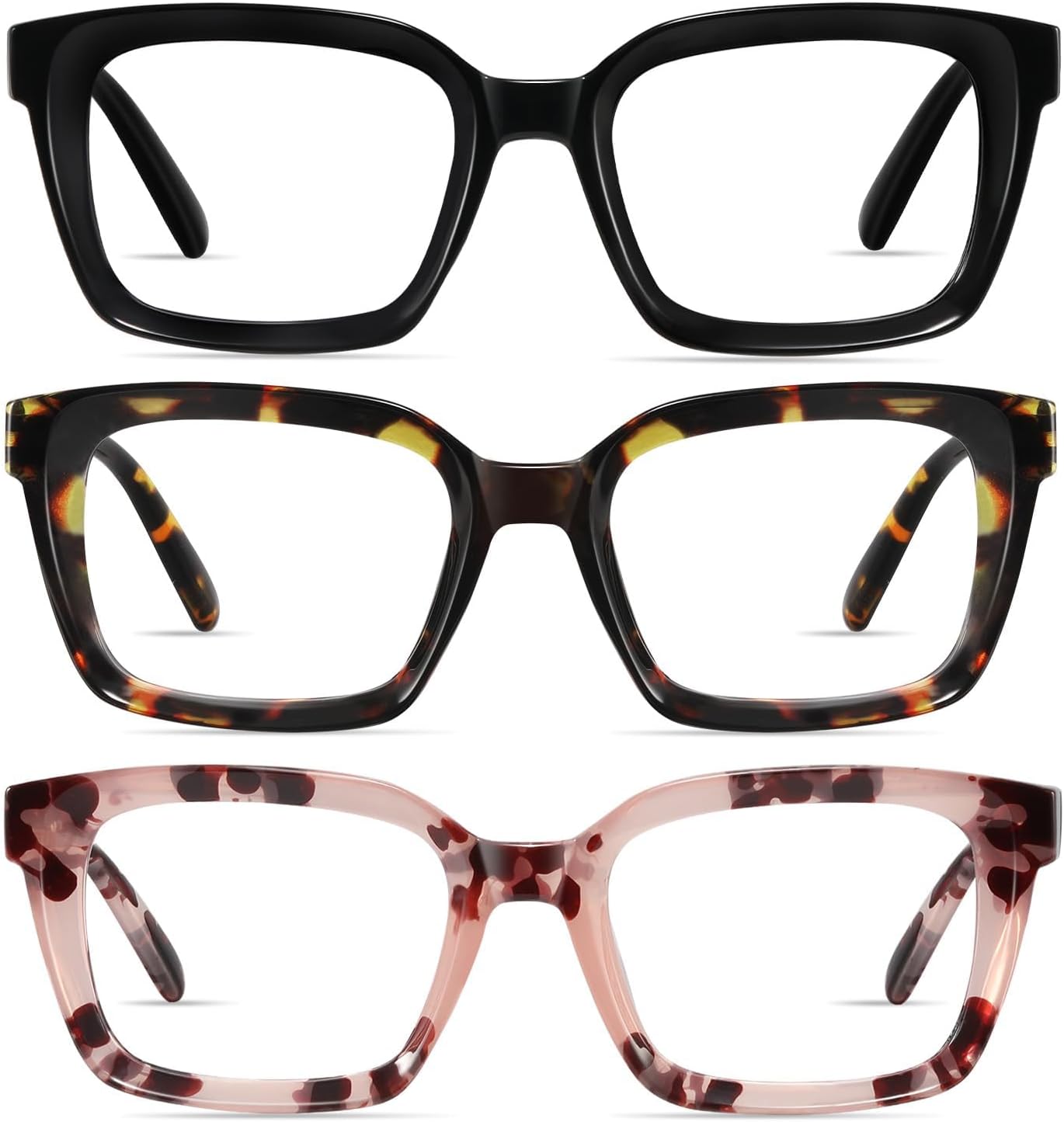
XVXV Reading Glasses for Women Men - Blue Light Blocking Readers Oversize Square Anti Glare with Spring Hinge
An Amazon's Choice three-pack of oversize square readers at $9.99 - about $3.33 a pair - rated 4.5 stars from 2,622 ratings and ranked #31 in Reading Glasses, with spring-hinge temples and lenses the listing says filter blue light as well as UV; sold in strengths from 0.0X to 4.0X.
$9.99 · Check Price on AmazonAs an Amazon Associate we earn from qualifying purchases.