Multifocal Fitting Height: Why the Reading Zone Has to Match Your Gaze
A reading zone is not a reading power
Two people can walk in with identical prescriptions, choose identical lens designs, and leave with multifocals that behave completely differently. The variable is not the optics. It is where the reading zone sits inside the frame.
The reason is structural. A single-vision lens has the same power across its whole surface, so almost any part of it will serve if the geometry is sensible. A multifocal does not work that way. It contains a distance zone, a near zone, and in a progressive lens an intermediate corridor connecting them, and those zones occupy fixed regions of the lens. For the lens to work, your eye has to be looking through the right zone at the right moment. If the near zone is positioned even a couple of millimetres away from where your gaze actually passes when you read, you will find yourself tilting your head, lifting your chin, or holding the book at arm's length to find the power you paid for.
So the vertical placement of the reading zone is a fitting decision, and it is made per person. The measurement that captures it goes by different names depending on the lens: segment height for a bifocal or trifocal, and fitting height for a progressive, where the reference point is the fitting cross marked on the lens.
What is actually measured
In a bifocal, the segment height is the vertical distance from the lowest point of the lens shape up to the top edge of the reading segment. In a progressive, the equivalent measurement runs from the lowest point of the lens up to the fitting cross.
Two features of that definition matter more than the number itself.
First, it is measured from the bottom of the lens shape, not from the centre of the frame or from the hinge. This is because the lens is cut to the shape of the frame, and what constrains a reading zone is how much lens there is beneath it. If you change frames, the same lens cannot simply be moved across; the geometry beneath the reading zone changes with the new shape.
Second, the measurement is expressed to a precision of about half a millimetre. That level of precision looks excessive until you consider what a millimetre means at reading distance. When you look straight down through a lens, each millimetre of vertical displacement changes the viewing angle noticeably; a two-millimetre error is comfortably enough to place your line of sight outside the near zone for a narrow corridor design.
Where the reference point comes from
The measurement is not arbitrary, because there is a physical landmark that predicts where your eye will be when you look down. For a bifocal, the segment top is normally placed level with the lower eyelid margin, so that the reading zone begins exactly where your downward gaze crosses the lens. For a progressive, the fitting cross is placed over the pupil and the near zone is positioned below it, so that the corridor sits in the path your eye follows as it moves from distance to near.
Why the frame comes first
The most common reason a multifocal cannot be fitted as requested is not the prescription. It is the frame.
A lens shape has a vertical dimension — the industry term is the B measurement, the height of the lens outline in the boxing system. The reading zone has to fit somewhere inside that height, below the fitting cross or segment top and above the frame edge. A shallow frame simply does not contain the required vertical distances. If the lens shape is too short, the fitting cross has to be pushed upward toward the frame rim, which moves the distance zone out of the useful area and leaves the near zone squeezed into the bottom edge.
This is why an optician may decline to put a progressive into a frame you have already chosen, or recommend a shorter corridor design. It is also why the same progressive lens that works beautifully in one frame can be uncomfortable in a shallower one. The lens has not changed; the amount of lens available beneath the fitting cross has.
Frame choice interacts with lens power as well. A stronger prescription needs more thickness at the edges of a lens, and the shape and depth of the frame determine how much edge thickness is left once the lens is cut. If you are working through the trade-offs between frame size, lens power and lens material, our lens thickness calculator shows how those variables move together before you commit to a frame.
Segment width is a separate decision
Common misconceptions
- "Segment height is a standard number." It is a measurement of your face in a particular frame. Two people with identical prescriptions can need different values, and the same person can need a different value after changing frames.
- "If the reading part is in the wrong spot, you will get used to it." Adaptation helps with the peripheral distortion of a progressive design. It does not move a reading zone. If you must tilt your head to find the near power, the fitting height is wrong, and no amount of adaptation will fix a geometric error.
- "A bigger frame gives more room, so it must be better." A deeper frame provides more vertical room, but it also increases edge thickness and weight at high powers, and it may place the lens's optical centre further from your pupil. More room is not automatically better positioning.
Signs the height is wrong
A few specific experiences point at fitting height rather than at the prescription or the design:
- Near vision is clear only when you lift your chin or hold the page unusually far away.
- You see the reading line — or the top of the reading zone — while walking or looking at something in the distance.
- Reading is comfortable but looking up across a room requires a deliberate head movement to escape the near zone.
- The blur has a clear vertical boundary: clear below a certain point on the lens, blurred above it, in a way that does not move when you blink.
When to go back rather than persist
If your near vision is only clear in one head position, or you are aware of the segment line in situations where you should not be, return to the practice that dispensed the glasses and describe the behaviour in those terms. "I have to tilt my head back to read" is a much more useful description than "the glasses feel wrong", because it points directly at vertical positioning.
Editor's Picks

CCVOO Reading Glasses for Women with Blue Light Filter
$9.98 for the #2 best-selling reader in Amazon's Reading Glasses chart - an Amazon's Choice pick rated 4.5 stars from 4,045 ratings with 3K+ bought in the past month; polycarbonate frame and lenses with blue-light filtering, spring hinges and a rectangular full-rim shape, in strengths from 0.0 up to 6.0.
$9.98 · Check Price on Amazon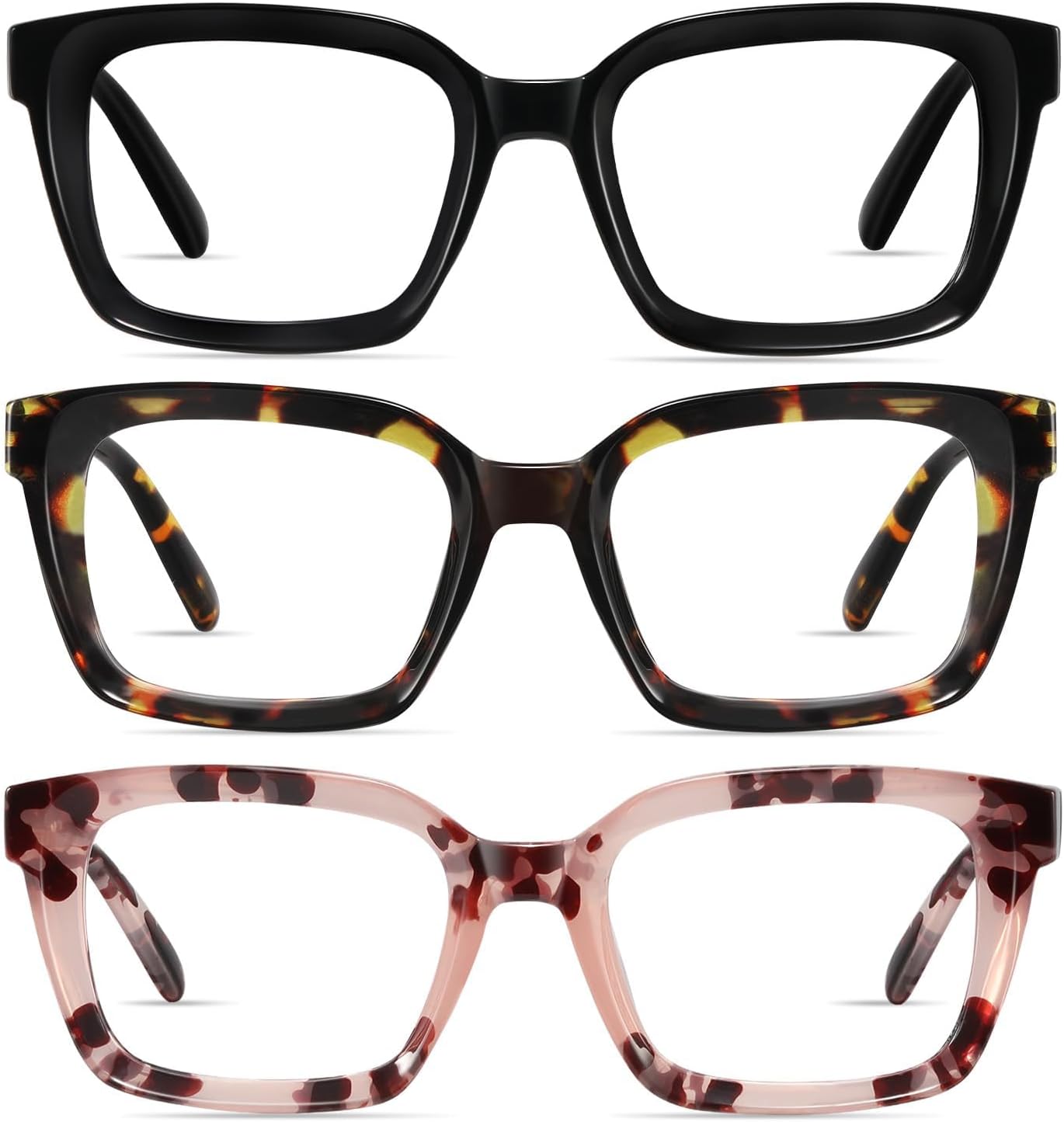
XVXV Reading Glasses for Women Men - Blue Light Blocking Readers Oversize Square Anti Glare with Spring Hinge
An Amazon's Choice three-pack of oversize square readers at $9.99 - about $3.33 a pair - rated 4.5 stars from 2,622 ratings and ranked #31 in Reading Glasses, with spring-hinge temples and lenses the listing says filter blue light as well as UV; sold in strengths from 0.0X to 4.0X.
$9.99 · Check Price on AmazonAs an Amazon Associate we earn from qualifying purchases.