Bifocal Segment Designs Explained: Flat-Top, Round and Executive
The part of a bifocal that nobody explains
A bifocal lens has two optical powers cut into one piece of material. Almost all the discussion around them focuses on that fact — distance on top, reading below. What gets skipped is the thing that actually determines how a bifocal feels to wear: the geometry of the reading segment, and in particular where its optical centre sits relative to the line you are looking through.
Two patients can be given "bifocals with a +2.00 add" printed on the same order and have completely different experiences, because the segment design was different.
The principle layer: optical centre and image jump
Every lens has an optical centre — the point through which light passes undeviated. Looking away from that point introduces prism, and the amount of prism grows with the distance from the centre.
When you drop your gaze from the distance portion into the reading segment, your line of sight crosses the segment boundary and immediately transfers to the segment's own optical centre. If that centre is not sitting where your line of sight lands, the eye receives an abrupt step of prism at the boundary. That abrupt step is called image jump.
Your eye does not smoothly transition. It jumps, and the two images — one through the distance portion, one through the segment — are displaced relative to each other. The size of the jump depends almost entirely on how far the segment's optical centre is from the top edge of the segment, because that is the edge your gaze crosses.
This is where the designs separate cleanly:
- Flat-top (D-segment or straight-top). The most widely used design. The segment has a straight horizontal top edge with a rounded bottom, giving a shape like a capital D. Common widths are 22 mm, 25 mm and 28 mm. Critically, the optical centre of the segment sits about 5 mm below the top line. That offset is what creates image jump — but it is also what makes the design practical, because the segment is wide and shallow, so a normal reading posture uses it comfortably.
- Round segment. A circular reading segment. The optical centre sits at the geometric centre of that circle. Because the segment is small and its centre is deep inside it, the jump behaviour differs from a flat-top — and the useable reading area is narrower, which is why round segments are less common in general dispensing.
- Executive (Franklin). The original bifocal construction, and still the one that behaves most like two lenses joined. The dividing line runs the full width of the lens, and the reading portion occupies the entire lower half. There is effectively no image jump at the boundary, because there is no discontinuous shift of optical centre. The trade-offs are appearance, cost and thickness, not optics.
The pattern is worth stating plainly: a smaller, tucked-away segment generally means more image jump and less reading area; a full-width segment means less jump but a much more visible lens. Design is a compromise, not a hierarchy.
What the numbers mean on an order form
A bifocal order typically specifies the segment width — "28 flat top", for example — and separately a segment height, which is the vertical position of the segment's top edge measured from the bottom of the lens frame, or referenced to the pupil. Segment height is the single most consequential number in the whole order, and it is a fitting decision rather than a prescription decision. Put it too low and the patient has to tilt their head down and look under the segment to read. Put it too high and the segment intrudes on distance vision, appearing as a visible line across the middle of the field.
This is also why bifocals cannot sensibly be bought by measuring your own eyes at home. The prescription can be copied. The segment height cannot, because it depends on where your pupils sit in that specific frame on your specific face.
Common misconceptions
"Bifocals are obsolete; everyone should get progressives." Progressives remove the visible line and the image jump, but they introduce peripheral aberration and a narrower corridor of clear vision. For some tasks and some wearers — particularly people who want a wide, stable reading area and do not mind the line — a flat-top bifocal genuinely performs better. It is a different compromise, not an older one.
"The line is what causes the jump." The visible line is an appearance feature. The jump comes from the position of the segment's optical centre relative to the boundary. An executive bifocal has a very obvious line and essentially no jump.
"A bigger segment is always better." A wider segment trades away distance vision and increases lens thickness and weight at the bottom edge. The right width depends on the reading task and the frame depth.
"If it feels wrong, the add power is wrong." A wrong-feeling bifocal is at least as likely to be a segment height or centration problem as a power problem — and those are fixed by re-measuring the fit, not by changing the prescription.
When to see an optometrist or ophthalmologist
Go back to your optometrist if you find yourself lifting your chin, tilting your head, or repeatedly looking above or below the segment to read. Those are fit problems, and they are usually measurable and correctable.
If a bifocal produces double vision, a persistent pulling sensation, or a feeling that your eyes are fighting each other, have it assessed rather than adapting around it. Those symptoms can indicate that the prism imbalance between the two portions of the lens is not being tolerated, and in some cases they point to a binocular vision issue that deserves proper examination rather than a lens tweak.
And if you are choosing between a bifocal and a progressive, the honest framing is that you are choosing which set of compromises you would rather live with. Ask to see the segment options and how they sit on your face — the geometry, not the marketing, is what you will actually feel.
Editor's Picks

CCVOO Reading Glasses for Women with Blue Light Filter
$9.98 for the #2 best-selling reader in Amazon's Reading Glasses chart - an Amazon's Choice pick rated 4.5 stars from 4,045 ratings with 3K+ bought in the past month; polycarbonate frame and lenses with blue-light filtering, spring hinges and a rectangular full-rim shape, in strengths from 0.0 up to 6.0.
$9.98 · Check Price on Amazon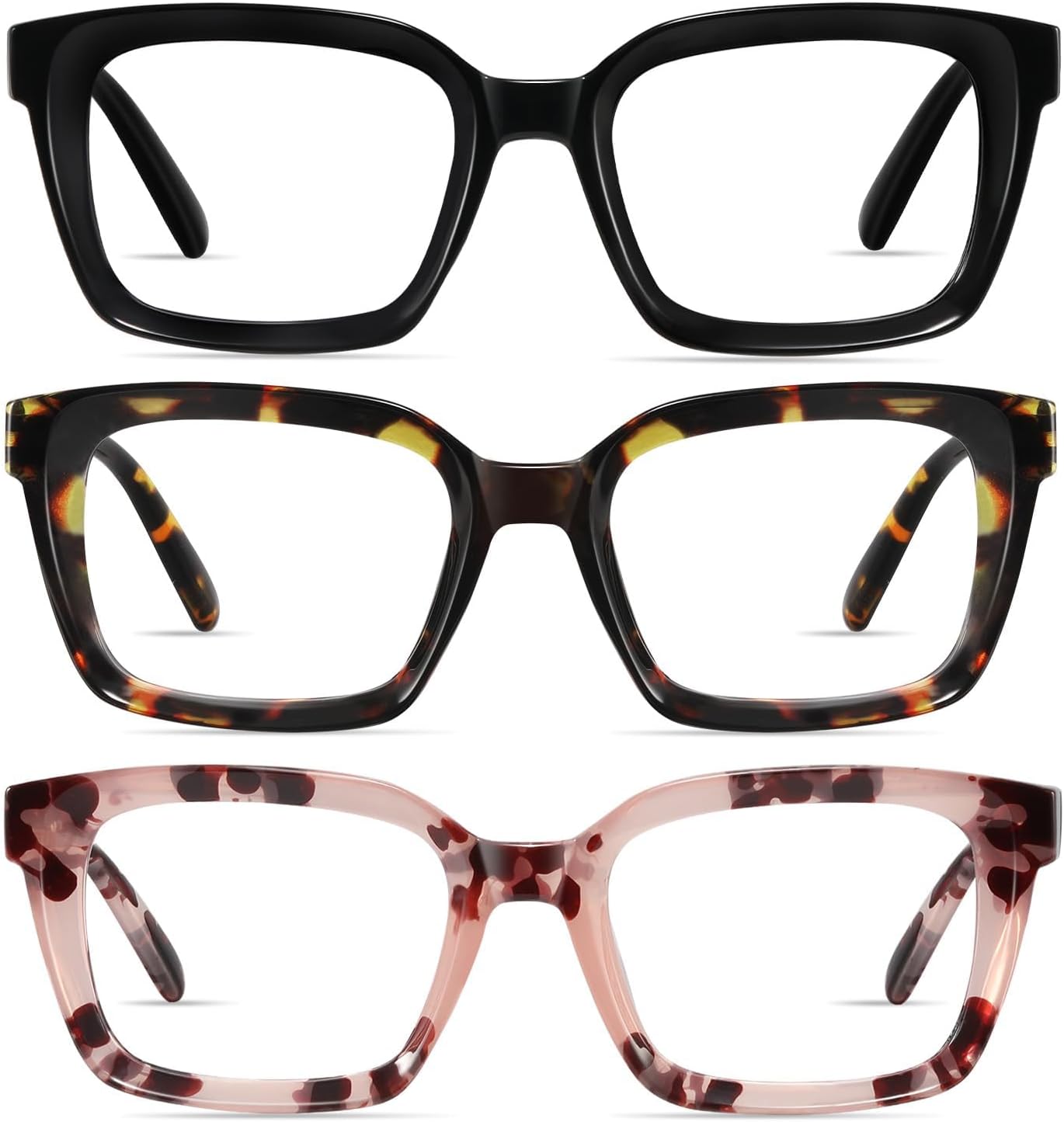
XVXV Reading Glasses for Women Men - Blue Light Blocking Readers Oversize Square Anti Glare with Spring Hinge
An Amazon's Choice three-pack of oversize square readers at $9.99 - about $3.33 a pair - rated 4.5 stars from 2,622 ratings and ranked #31 in Reading Glasses, with spring-hinge temples and lenses the listing says filter blue light as well as UV; sold in strengths from 0.0X to 4.0X.
$9.99 · Check Price on AmazonAs an Amazon Associate we earn from qualifying purchases.