Presbyopia: Why Your Near Point Moves Away After 40
The autofocus you never noticed having
Look up from this page at something across the room. Your eyes refocused, and you felt nothing happen. That adjustment is accommodation, and it is the reason presbyopia exists as a separate problem from long-sightedness. A camera changes focus by moving a lens group. The human eye changes focus by changing the shape of a single lens, and that lens becomes less willing to change shape as the years pass.
The mechanism: a lens that stiffens as it grows
The crystalline lens sits behind the iris, suspended by a ring of fibres called the zonules, which connect it to the ciliary body. In the classic description, contraction of the ciliary muscle slackens the zonules and lets the lens spring into a rounder, more powerful shape for near vision; relaxation pulls the zonules taut and flattens the lens for distance.
The key structural fact is that the lens keeps growing throughout life. New fibres are laid down in shells, like the rings of a tree, and the older, denser material is compressed toward the centre. The result is a lens that becomes thicker and stiffer with age. A stiffer lens cannot change shape as far for the same muscular effort, and the capsule that encloses it also changes its properties. Accommodation therefore declines not because the focusing muscle weakens, but because the lens itself becomes progressively less deformable — a mechanical limit rather than a muscular one.
The numbers: amplitude and the near point
The clinical quantity is the amplitude of accommodation: the difference in optical power the eye can add, measured in dioptres, between its fully relaxed state and its maximum effort. It is closely tied to the near point — the closest distance at which something can be held and still be seen sharply. The dioptric equivalent of a near point distance in centimetres is 100 divided by that distance, so a near point of 25 cm corresponds to 4 dioptres of accommodation in use.
Amplitude declines steadily and predictably. Published figures vary with measurement method — subjective push-up testing and objective techniques do not agree perfectly — but the shape of the curve is consistent. One large adult study reported an average amplitude of roughly 7.5 dioptres in the 35–40 age band with a decline of about 0.23 dioptres per year. Historical clinical reports, including Duane's early work, placed the usual age of onset in the range of about 38 to 48 years, and modern reviews note that the amplitude is close to fully lost by the early-to-mid fifties.
Why the forties are the tipping point
Near vision does not need the full amplitude. Comfortable sustained reading typically uses something in the region of the closer half of the available range, because holding focus at the absolute limit is fatiguing. That reserve is what makes the arithmetic work out the way it does: at a comfortable 40 cm reading distance the eye needs about 2.5 dioptres in use. Somewhere in the early forties the remaining amplitude, minus a workable reserve, stops covering that demand for any length of time. The person has not lost a skill they once had; they have run out of margin.
This also explains two details that surprise people. First, that presbyopia starts with fatigue and with holding things further away, not with an abrupt blur. Second, that it progresses: the same person who needed a small reading addition at 44 typically needs a larger one at 55, because the underlying amplitude keeps falling.
It is also worth separating presbyopia from hyperopia. Someone who is long-sighted has been compensating with accommodation all along, so their reserve runs out earlier and presbyopia can become noticeable in the late thirties. Someone who is short-sighted may find they can still read comfortably without any correction by removing their distance glasses — not because their lens has stayed flexible, but because the myopic defocus happens to land the near point at a usable distance.
Common misconceptions
"Presbyopia is a disease of the eye muscles." The focusing muscle is generally still capable. The limiting factor is the stiffening of the lens itself, which is why exercises do not restore a lost amplitude and why the change keeps progressing regardless of effort.
"Reading glasses will make my eyes weaker." Using a reading addition does not accelerate the underlying loss of amplitude, which is structural. It is common to need a stronger addition later, and that reflects the underlying progression, not the use of the glasses.
"Everyone becomes presbyopic at exactly 40." Onset is a range, not a date. It depends on the refractive error, on working distance, on how much sustained near work the person does, and on individual anatomy. Two people the same age can differ by years.
"Over-the-counter readers are the same thing as a proper prescription." Ready-made readers give the same power to both eyes and take no account of astigmatism, of a difference between the two eyes, or of the distance at which you actually work. They can work well for a straightforward case and poorly for an asymmetric one.
When to see an optometrist or ophthalmologist
See a professional for a proper refraction when near vision starts to limit what you do, when you find yourself extending your arms to read, or when headaches and eye strain appear after close work. Do not self-select a strength by guessing from a shop display — the addition depends on your distance prescription and your working distance, and it needs measuring.
Some changes are not ordinary presbyopia and should be assessed rather than worked around: a sudden change in near vision, vision that differs markedly between the two eyes, distortion rather than simple blur, or any loss of vision that develops quickly. A routine eye examination also checks the health of the eye itself, which is a separate matter from how well it focuses.
Editor's Picks

CCVOO Reading Glasses for Women with Blue Light Filter
$9.98 for the #2 best-selling reader in Amazon's Reading Glasses chart - an Amazon's Choice pick rated 4.5 stars from 4,045 ratings with 3K+ bought in the past month; polycarbonate frame and lenses with blue-light filtering, spring hinges and a rectangular full-rim shape, in strengths from 0.0 up to 6.0.
$9.98 · Check Price on Amazon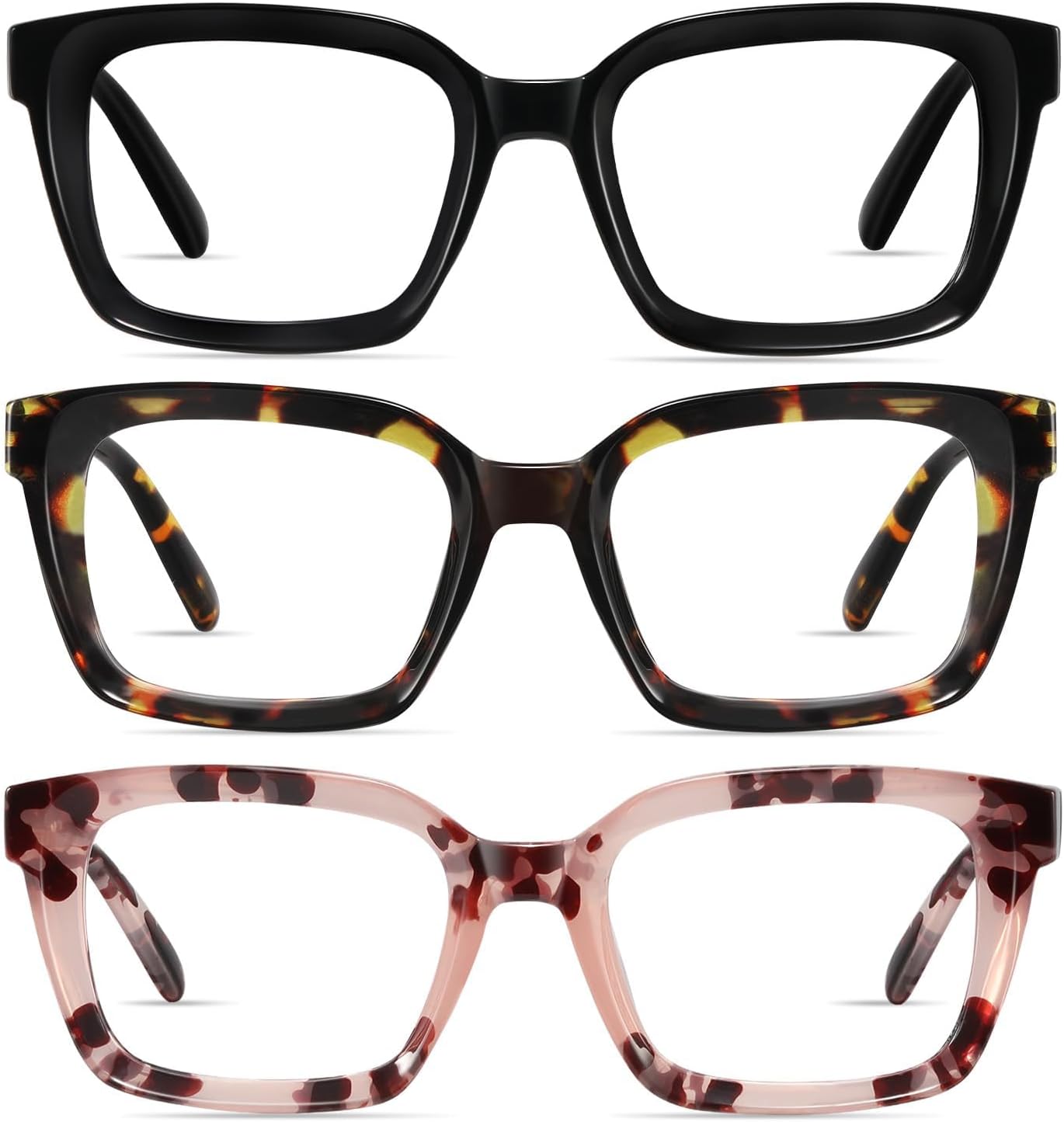
XVXV Reading Glasses for Women Men - Blue Light Blocking Readers Oversize Square Anti Glare with Spring Hinge
An Amazon's Choice three-pack of oversize square readers at $9.99 - about $3.33 a pair - rated 4.5 stars from 2,622 ratings and ranked #31 in Reading Glasses, with spring-hinge temples and lenses the listing says filter blue light as well as UV; sold in strengths from 0.0X to 4.0X.
$9.99 · Check Price on AmazonAs an Amazon Associate we earn from qualifying purchases.